

How Flexible Is a Saw Blade Factory in Production? A Complete Guide to Manufacturing Capabilities
In today's competitive power tool accessories market, production flexibility has become an important factor when choosing a reliable saw blade manufacturer. Customers are no longer looking only for standard products. They also expect manufacturers to provide customized solutions, accommodate different order quantities, and respond quickly to changing market demands.
As a professional saw blade manufacturer, we understand that every customer has different requirements. Some need TCT saw blades for aluminum cutting, while others require specialized blades for woodworking, construction, or stone processing.
In this article, we'll explore what production flexibility means in a saw blade factory, how manufacturers achieve it, and why it matters when choosing a long-term manufacturing partner.
What Does Production Flexibility Mean in a Saw Blade Factory?
Production flexibility refers to a factory's ability to adjust its manufacturing processes according to different customer requirements, product specifications, and order quantities.
In the saw blade industry, this may involve customizing blade diameters, bore sizes, thicknesses, tooth configurations, cutting materials, and other technical specifications.
For example, some customers require standard saw blades for regular distribution, while others need customized products designed for specific cutting applications.
A flexible manufacturer should be able to support different product categories, handle both standard and customized orders, and maintain consistent quality throughout the production process.
This flexibility allows distributors, wholesalers, and brand owners to develop product ranges that better match their target markets.
Our Saw Blade Product Range
A diverse product range is one of the foundations of production flexibility. By offering different types of saw blades, manufacturers can serve customers across multiple industries and applications.
Here are some examples of products in our range:
1. TCT Aluminum Saw Blades
TCT (Tungsten Carbide Tipped) aluminum saw blades are designed for cutting aluminum profiles, aluminum sheets, and other suitable non-ferrous metal materials.
Their carbide-tipped teeth provide good wear resistance and cutting performance. With the appropriate tooth geometry and cutting parameters, these blades can deliver clean cutting edges and help reduce burr formation.
They are widely used in aluminum processing, window and door manufacturing, and metal fabrication industries.
2. TCT Wood Saw Blades
Woodworking applications require different cutting characteristics depending on the type of wood and the desired finish.
Our TCT wood saw blades are designed for cutting various wood materials, including softwood, hardwood, plywood, and other wood-based panels, depending on the blade specifications.
Different tooth configurations and geometries can be selected to meet specific cutting requirements, helping achieve clean cuts, accurate dimensions, and reduced material chipping.
3. Abrasive Cutting and Grinding Discs
Abrasive cutting and grinding products are designed for processing different hard materials, depending on their abrasive composition and product specifications.
These products are commonly used in metal fabrication, construction, and other industrial applications.
By offering different abrasive products and specifications, manufacturers can provide additional cutting and grinding solutions for customers who require more than conventional saw blades.
4. 114 × 20 × 1.8 mm Wall Chaser Saw Blade
Specialized wall chaser blades are designed for creating grooves in walls for electrical wiring, plumbing installations, and other construction applications.
For this particular product, the 114 × 20 × 1.8 mm specification represents its dimensional configuration.
Offering specialized dimensions allows customers to select products that match their equipment requirements and specific working conditions.
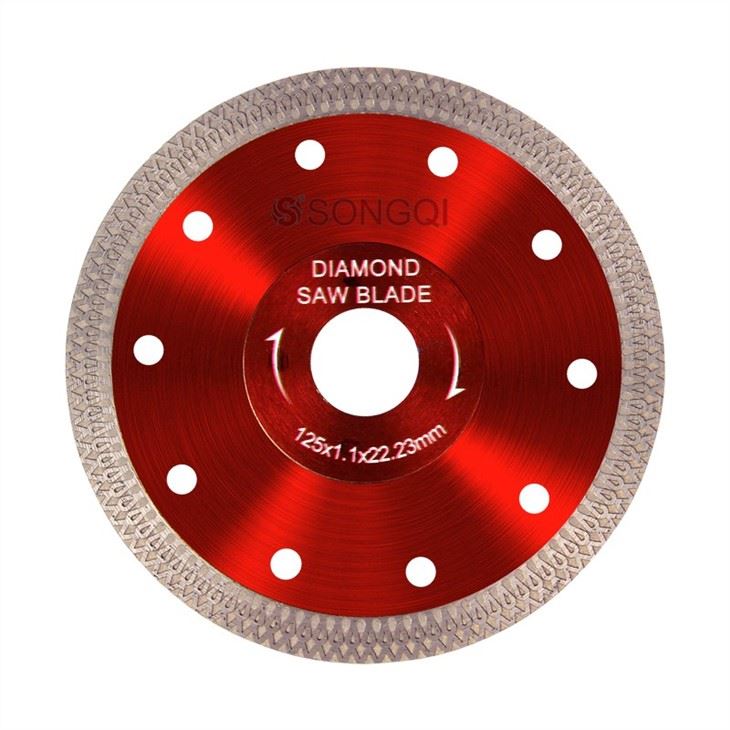
5. Corrugated Diamond Saw Blades
Diamond saw blades are designed for cutting hard and abrasive materials such as concrete, stone, ceramics, and other suitable materials.
The corrugated design can help improve debris clearance and cutting performance in certain applications.
Depending on the diamond concentration, segment structure, blade thickness, and intended material, different configurations can be developed to meet specific cutting requirements.
How Does a Saw Blade Factory Achieve Production Flexibility?
Offering a wide product range is only one part of production flexibility. Behind every customized order, there must be reliable manufacturing equipment, experienced workers, effective material management, and a well-organized production system.
Here are four important factors.
1. Advanced Manufacturing Equipment
Modern manufacturing equipment plays an important role in improving production flexibility.
With suitable machinery and adjustable production processes, manufacturers can produce saw blades in different diameters, thicknesses, and tooth configurations.
For example, when a customer requests a customized blade diameter, a different bore size, or a specific number of teeth, the production process can be adjusted according to the technical requirements.
This makes it possible to manufacture both standard products and customized saw blades.
Advanced equipment also helps improve dimensional accuracy, production consistency, and manufacturing efficiency.
2. Experienced Production Teams
Machinery alone cannot guarantee manufacturing quality. Skilled workers and experienced technical teams are equally important.
From raw material preparation and blade body processing to tooth brazing, sharpening, tensioning, and final inspection, every manufacturing stage requires appropriate technical knowledge and process control.
An experienced production team can adapt to different product specifications, identify potential production issues, and maintain consistent quality during product changes.
This is particularly important when handling customized orders that require different manufacturing processes.
3. Effective Raw Material and Inventory Management
Raw material availability directly affects production scheduling and delivery time.
A well-organized inventory management system helps manufacturers maintain appropriate stocks of essential materials, such as steel blade bodies, tungsten carbide tips, diamond segments, and other production components.
With sufficient material preparation, factories can reduce unnecessary purchasing delays and arrange production more efficiently.
However, customized products may require special materials or components that are not part of regular inventory. In these cases, material preparation and procurement lead times should be evaluated in advance.
Effective inventory management helps manufacturers respond more quickly to customer orders while maintaining reasonable production schedules.
4. Flexible Production Planning and Order Management
Production flexibility also depends on how efficiently a factory organizes its orders.
Different customers may have different requirements regarding order quantities, product specifications, packaging, and delivery schedules.
A well-organized production planning system allows manufacturers to coordinate different orders, arrange production batches, and reduce unnecessary machine changeover time.
For example, a factory may handle regular bulk orders while arranging smaller customized batches according to available production capacity.
This flexibility is particularly valuable for distributors and importers who need to test new products or gradually expand their product ranges.
Why Does Production Flexibility Matter to Buyers?
Choosing a flexible saw blade manufacturer offers several advantages for international buyers.
1. More Customized Product Options
Customers can select product specifications that better match their local markets and applications.
These may include blade diameter, bore size, thickness, tooth configuration, materials, and packaging requirements.
2. Greater Flexibility in Order Quantities
A manufacturer with flexible production arrangements may be able to support different order quantities, depending on product complexity and production capacity.
This is useful for distributors who want to introduce new products without immediately committing to large-volume purchases.
3. Better Market Responsiveness
Market demand and customer preferences can change quickly.
Working with a manufacturer that can adjust product specifications and production arrangements helps importers respond more effectively to new business opportunities.
4. More Efficient Production and Delivery Coordination
Flexible production planning and effective material management can help reduce unnecessary delays.
Although delivery times depend on order quantity, customization requirements, and material availability, a well-organized factory can provide more reliable production schedules and order updates.
Conclusion
So, how flexible is a professional saw blade factory in production?
Production flexibility is not simply about manufacturing different types of saw blades. It involves the combined capabilities of product development, manufacturing equipment, technical expertise, raw material management, and production planning.
A reliable manufacturer should be able to support different product specifications, respond to customized requirements, and maintain consistent quality across different order types.
At SONGQI, we understand that every market and customer has different needs. We aim to provide a diverse range of saw blades and power tool accessories, together with flexible manufacturing solutions to support our customers' businesses.
Whether you are looking for standard TCT saw blades, customized cutting solutions, or OEM/ODM manufacturing services, we welcome the opportunity to discuss your requirements.
**Looking for a flexible and reliable saw blade manufacturing partner? Contact SONGQI today to explore our product range and discuss your n

If you're interested in learning more about our saw blades or want to discuss a specific procurement need, don't hesitate to reach out to us. We're always ready to have a chat and find the best solution for you.
References
- General knowledge of saw blade production technology
- Internal factory records of product development and production processes